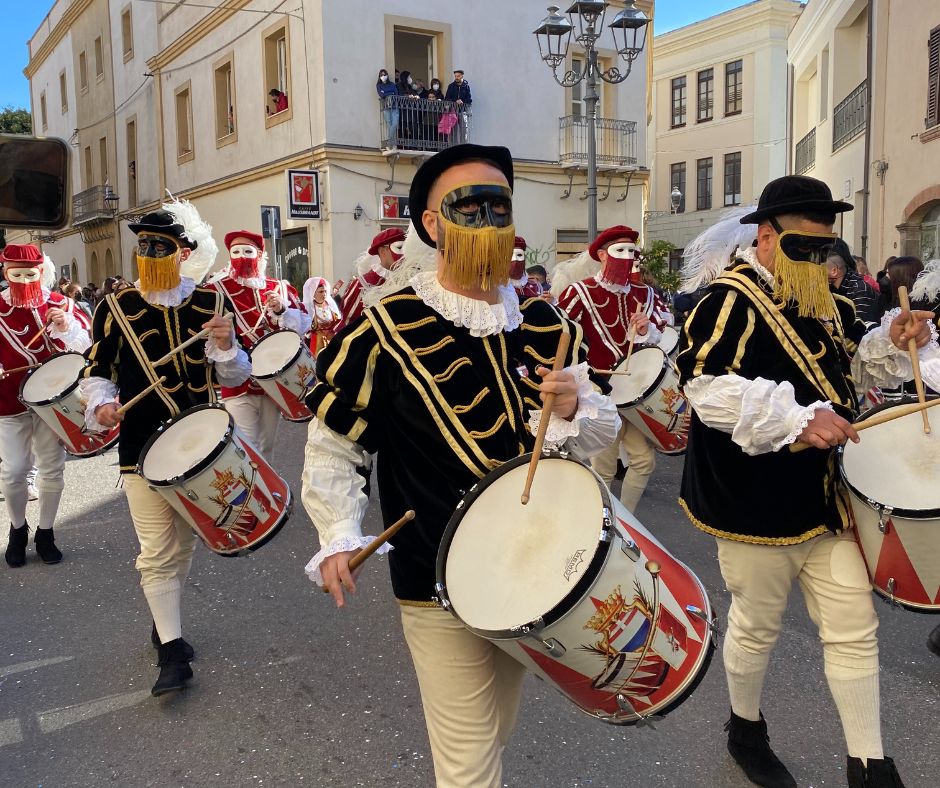
When it comes to Carnival in Sardinia, the first images that might come to mind are almost always those of the Barbagia hinterland, in the Nuoro area. The famous Mamuthonesblack masks, cowbells.
But the province of Oristano also has a long and lively carnival tradition, made up of different events, with distinct characters, worth seeing at least once in a lifetime. (And then a second. And maybe a third).
From Oristano to Bosa, via Santu Lussurgiu, Seneghe and Samugheo, Carnival changes shape from village to village. It can be elegant or chaotic, ritual or popular, orderly or completely out of control. One thing, however, does not change, here Carnival is still a feast felt and experienced first and foremost by those who live there.
All these events take place within an hour of distance from Nurapolis. Choosing to take a winter holiday here also means this. Discovering a less-told side of Sardinia, made up of full squares, delicious food, traditions that endure and events that, year after year, attract an ever-growing public.
Sartiglia
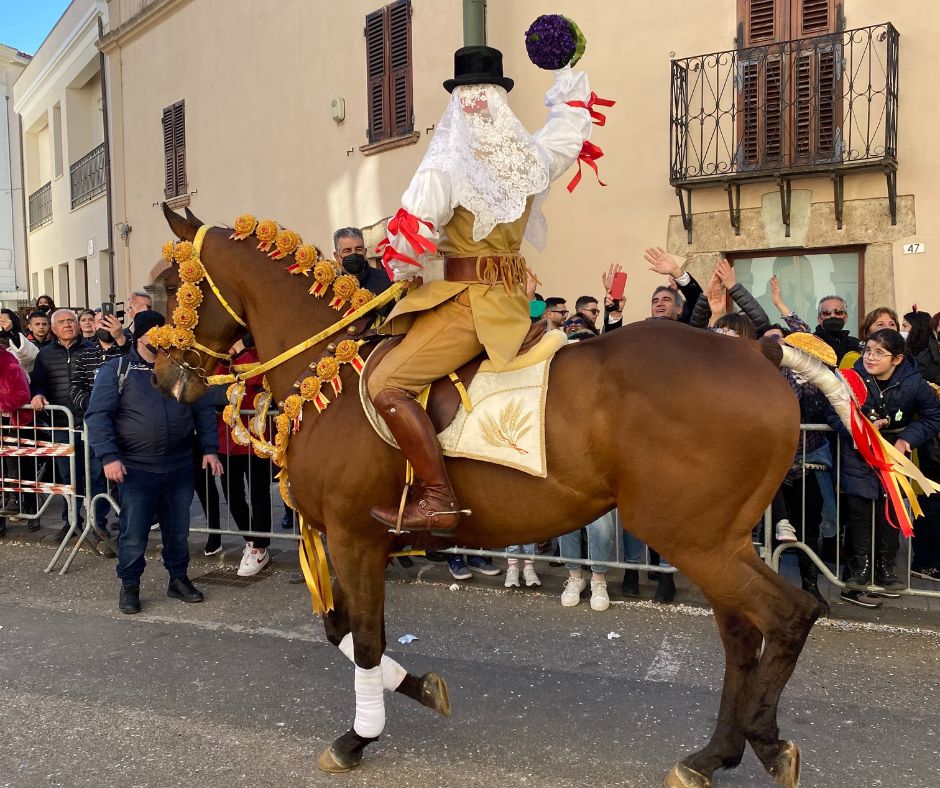
Yes, Sartiglia takes place in Oristano. It is one of the most heartfelt Carnival events in the area and always lasts three days: Sunday, Monday, and Tuesday. On Sunday, the race is organised by the farmers' gremio, on Tuesday by the carpenters' gremio, while Monday is dedicated to the Sartigliedda, the version for young people.
The absolute protagonist is On Componidori, the Corsican chief. His dressing is a long and very precise ritual performed by the women, the Massaieddasled by the Massaia manna. From that moment on, Su Componidori is no longer an ordinary person, but a symbolic figure whose task it is to lead the race.
After the crowd's blessing, Su Componidori opens the race by first attempting to pierce a hanging star with his sword. Immediately afterwards he selects the horsemen who will take part in the joust. The race to the star is the most eagerly awaited moment, the horsemen, galloping, try to hit the star with their sword or stock. According to tradition, the more stars are pierced, the better the year's harvest will be. This is followed by the pariglie, acrobatic evolutions on horseback that require training and coordination. Riders prepare for this moment all year round. The event ends with sa remadawhen Su Componidori, lying on the back of his horse, rides down the track blessing the crowd.
Meanwhile, outside the official route, Oristano is celebrating. The centre fills with people, music and outdoor tables. People eat, drink Vernaccia and stop to watch, comment and be together.
Sa Carrela 'e Nanti di Santu Lussurgiu
The Carnival of Santu Lussurgiu is related to the horse race called Sa Carrela 'e Nanti. The name derives from the street where the event takes place, the old main street of the village, today's Via Roma, which is made unpaved for the occasion.
The course is about 350 metres long and runs through the old town, with ascents, descents, bends and narrow sections. The riders, all from Lošinj, participate alone or in pairs or three. The pairs run together, holding each other by the arms, and arrive together. The crowd is also an integral part of the event. They line the route and open up just before the arrival of the horses, only to close again immediately after their passage.
According to tradition, knights must wear a mask or have their faces painted. The clothing, called sa mascheradais rich in colour and fantasy. It may recall Spanish costumes, jockey's tunics or elements of the village's old clothing, such as the orbace jacket, the leather corset and the berretta longa.
The event takes place over three days. Sunday and Tuesday are dedicated to parilla races. Monday, known as the day of the hen, features a different test, in which the riders have to hit a puppet while galloping. On these days, the village fills up, the race remains the centre of the festivities, and eating, drinking and fun continue to take place all around.
Carnival of Bosa
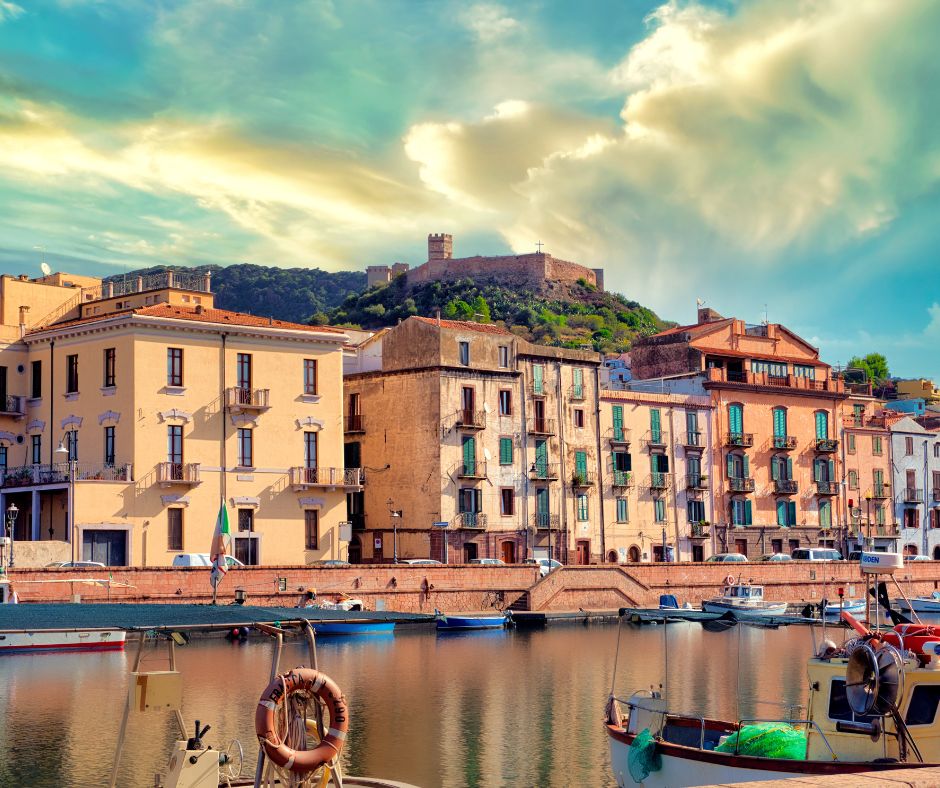
Enjoy an Bosa Carnival is known as Karrasegare and is, first and foremost, a community party. Here, roles are loosened and satire takes space. People and situations are sung about, joked about, and mocked, often improvising ironic verses to the melodies of traditional songs.
The party already starts a week before Shrove Thursday, when masked groups go from house to house to sa palte 'e cantare. People sing, ask for food and drink, and in return, sausages, cheese, sweets and wine are put together for the big dinner. The central moment, however, comes on Shrove Tuesday, when the whole community takes to the streets in disguise.
The protagonist is Gioldzi, or King George, symbol of Carnival, represented by a rag doll with a barrel for a belly. Around him move the Attittadorasdressed in black, who from morning onwards mournfully announce his death with sung funeral laments. The audience does not just stand by and watch, they are involved, called in, often dragged into the scene.
Throughout the day, people dance, sing and drink together, until the scene changes at sunset. The black masks make way for the white ones, the souls of Carnival. With lit lanterns they seek Gioldzi, which is then burnt in a final stake, a symbol of closure and purification. And the feast continues.
Carnival of Samugheo
The Carnival of Samugheo is probably the one that comes closest to the Carnivals of the Nuoro hinterland. Here, the masks are central and the ritual is called To Maimonea tradition linked to the agro-pastoral world.
The main protagonists are Su Mamutzone, S'Urtzu and S'Omadore. Su Mamutzone is a silent mask, with a blackened face and body covered in goat skins and cowbells, recalling the world of shepherding. S'Urtzu represents the victim of the ritual and is dressed in dark skins, while S'Omadore, the shepherd, guides him during the parade.
The masks come out at nightfall at various times during Carnival. The first event is on 16 January, on the feast of Saint Anthony Abbot. But the carnival proper then starts on Shrove Thursday with the dressing up and continues on the evening of Thursday, Sunday and Carnival Tuesday.
The ritual unfolds as a procession through the village. The Mamutzones advance by ringing their cowbells, while S'Urtzu is led, struck and dropped several times. The scene follows a precise sequence that recalls the cycle of death and rebirth, linked to the fertility of the earth. At the end of the parade, the celebration continues in the square with dancing.
To Maimone is also a moment of encounter. Over the years, alongside the masks of Samugheo, groups from other parts of Sardinia, the peninsula and Europe have begun to participate. The result is a Carnival very much rooted in tradition, but open to exchange.
Carnival of Seneghe
In Seneghe, Carnival begins on 20 January, with celebrations in honour of San Sebastiano, the patron saint of the village. From here takes shape what is considered the last carnival danced of Sardinia, a tradition that continues every Sunday afternoon and evening, in addition to the days of the Candlemasof the Maundy Thursdayof the Monday and the Carnival Tuesdaywhen dancing in the morning and in the evening.
The heart of the festival is the traditional village danceaccompanied by the accordion or tenor singing in the local form of su ballu e cantidu. Precise rules apply in the square: the men line up in rows, the women invite people to dance and, between dances, they advance along the line to dance with everyone.
The dance is open to people from the village, with no age limit. Those who come from outside can participate, respecting the rules of the square, except on Tuesday mornings, when sas andanzas are exclusively reserved for Senegalese in traditional dress.
During Carnival, the committee offers red wine to those present, in return for a free offer; on Tuesday mornings we only drink white wine. Over the years, a spontaneous party has also sprung up, 'Open bonnets': On the morning of Shrove Tuesday, in the streets around the ball square, the boots of cars open up and become improvised tables, amidst wine and homemade specialities, in a heartfelt atmosphere of sharing.